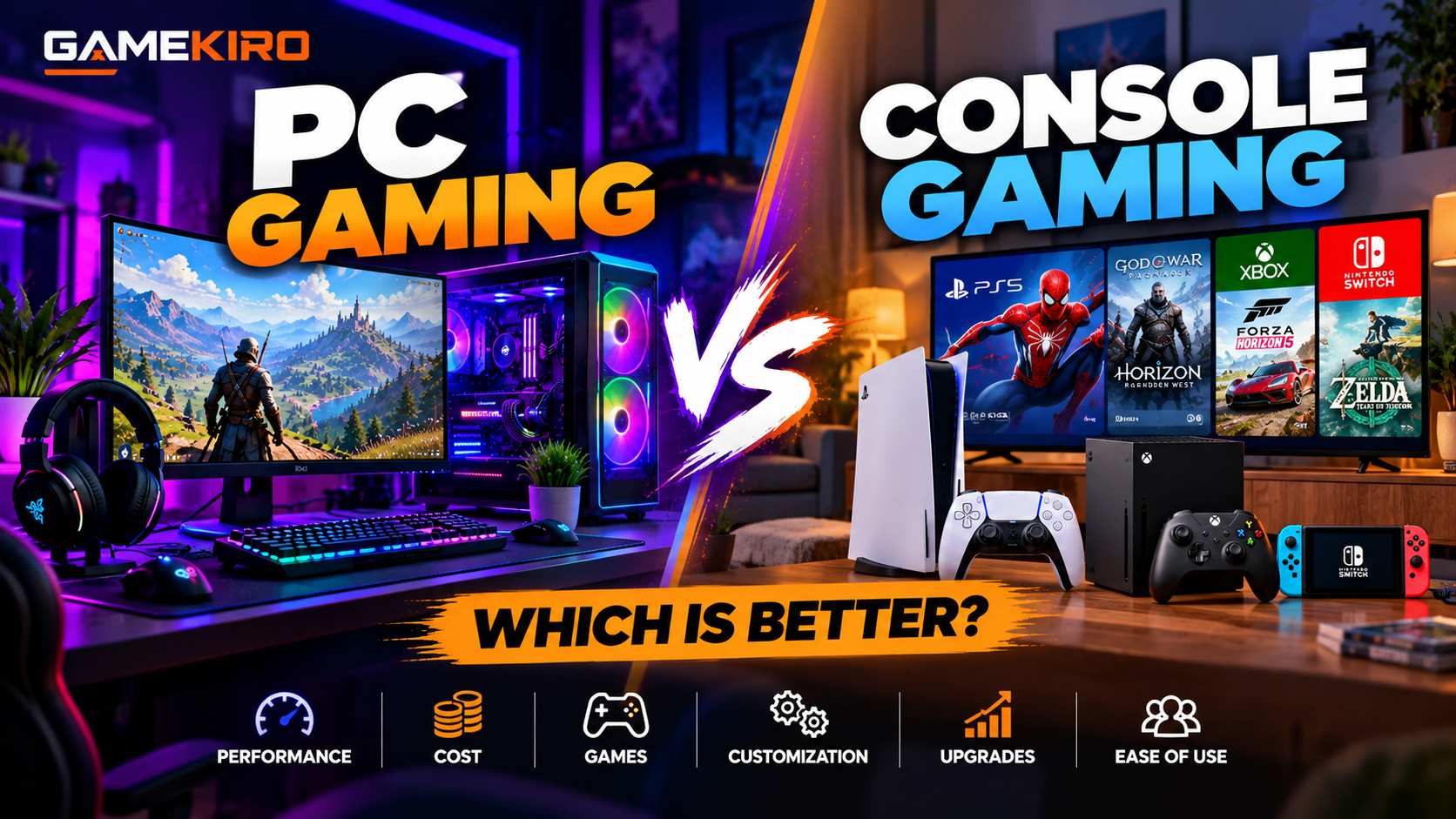
PC Gaming vs Console Gaming: Which Is Better?
Gaming has become one of the most popular forms of entertainment worldwide, but choosing the right gaming platform can be confusing for beginners. Should you buy a gaming PC, or is a console such as PlayStation or Xbox a better choice?
Both platforms offer excellent gaming experiences, but they differ in price, performance, game selection, customization, and convenience. The best option depends on your budget, the games you want to play, and how you prefer to enjoy them.
In this guide, Gamekiro compares PC gaming vs console gaming to help you decide which platform is better for your needs in 2026.
1. What Is PC Gaming?
PC gaming means playing video games on a desktop computer or laptop. Players can use a keyboard and mouse, a controller, or other compatible accessories.
One of the biggest advantages of PC gaming is flexibility. You can choose different hardware configurations, adjust graphics settings, upgrade selected components, and use your computer for activities beyond gaming.
PC players can access games through platforms such as Steam, the Epic Games Store, and other digital storefronts. Depending on the game, they can also use community-created modifications, customize controls, and play older titles.
However, a gaming PC may require more initial planning than a console. Buyers need to consider the processor, graphics card, memory, storage, monitor, and other components to ensure their system meets their needs.
2. What Is Console Gaming?
Console gaming involves playing video games on dedicated gaming systems such as PlayStation, Xbox, and Nintendo Switch.
Consoles are designed to provide a straightforward gaming experience. Connect the system to a display, complete the initial setup, install or launch a game, and start playing.
Unlike a desktop gaming PC, a console uses a fixed hardware configuration. Game developers optimize their titles for that hardware, so players generally do not need to adjust as many technical settings.
Consoles are particularly convenient for living-room gaming, family entertainment, and playing with friends using controllers.
The main limitation is flexibility. You generally cannot upgrade a console's processor or graphics hardware, and some games are available only on particular platforms.
3. PC Gaming vs Console Gaming: Key Differences
Feature| PC gaming| Console gaming
Initial cost| Can be higher| Often lower for entry-level gaming
Graphics settings| Highly customizable| Usually preset or limited options
Performance| Depends on hardware and settings| Optimized for fixed hardware
Upgrades| Many components can be upgraded| Primarily storage and accessories
Controls| Keyboard, mouse, controllers| Primarily controllers
Game selection| Large variety, including PC-exclusive titles| Platform libraries and exclusives
Online multiplayer| Usually no platform-wide subscription fee| Subscription often required for paid games
Mods| Supported in many games| Limited or game-dependent
Setup| May require configuration| Generally straightforward
Other uses| Work, study, editing, streaming| Primarily gaming and media
These are general differences. Features, prices, subscription requirements, and game availability vary by platform and individual title.
4. Which Offers Better Graphics and Performance?
PC gaming generally offers a higher performance ceiling because players can choose powerful processors, graphics cards, and high-refresh-rate monitors.
Depending on the hardware and game, a gaming PC can deliver high frame rates, detailed graphics, advanced visual effects, and support for ultrawide displays. Players can also lower graphics settings to prioritize smoother gameplay.
Consoles offer a more standardized experience. Developers optimize games for the available hardware, and many titles provide different modes that prioritize visual quality or performance.
For example, a game might offer a quality mode with more detailed graphics and a performance mode designed for smoother movement. Some console games support 120 frames per second, but availability depends on the title, display, and selected settings.
Neither platform guarantees better results in every game. A powerful PC can outperform a console, but an inexpensive PC may perform worse than a console that costs less.
Verdict: PC gaming wins for customization and maximum performance potential. Consoles remain competitive because developers optimize games for their specific hardware.
5. Which Is Cheaper: PC or Console?
Cost is one of the most important factors when choosing between PC gaming and console gaming.
A console is often the more affordable way to start playing demanding modern games. You generally purchase the system, connect it to a compatible television or monitor, and begin playing.
A gaming PC can cost more upfront, particularly if you need to purchase a monitor, keyboard, mouse, and other accessories. However, a computer can also serve as a workstation for studying, office tasks, video editing, and other activities.
Long-term expenses matter too. PC games frequently receive discounts through digital storefronts, and most PC games do not require a separate platform subscription for online multiplayer. Console owners may need a paid subscription for online multiplayer in many paid games, although exceptions exist.
Both platforms involve game purchases, accessories, optional subscriptions, and possible repairs or upgrades.
To compare costs fairly, consider the complete setup rather than the device price alone. A used PC, an existing computer, or a discounted console bundle can change the calculation considerably.
Verdict: Consoles usually win on entry cost. PCs can offer more flexibility and value over time, especially when the computer also serves other purposes.
6. Which Has Better Games?
Game availability can be more important than technical specifications. The best platform is the one that lets you play the titles you enjoy.
PC gaming offers a broad selection of genres, including strategy games, simulations, independent games, competitive shooters, and multiplayer experiences. Many older PC titles remain playable, depending on operating-system and hardware compatibility.
Consoles offer their own libraries and platform-specific releases. PlayStation, Xbox, and Nintendo systems have different strengths, and certain franchises may be a deciding factor for fans.
The distinction between platforms is less absolute than it once was. Some games support cross-platform play, allowing people on different systems to play together. Some previously exclusive games have also been released on additional platforms.
However, cross-play and cross-progression are not universal. Check compatibility before buying a game if you want to play with friends on another system.
Verdict: PC is excellent for variety and older games, while consoles may be the better choice if you want specific platform-exclusive titles.
7. Which Is Easier for Beginners?
Consoles generally have the advantage when it comes to simplicity. Their interfaces are designed around gaming, and players usually do not need to research hardware compatibility or install graphics drivers manually.
PC gaming requires a little more technical knowledge. You may need to manage software updates, choose graphics settings, troubleshoot performance problems, and understand minimum system requirements.
However, modern PC gaming is more accessible than it used to be. Prebuilt gaming computers, automatic updates, controller support, and TV-friendly interfaces make it easier for beginners to get started.
For example, Steam's Big Picture mode provides a full-screen interface designed for television and controller use. <Link url="https://help.steampowered.com/en/faqs/view/3725-76D3-3F31-FB63" title="Learn about Steam Big Picture mode"/>.
Verdict: Consoles are usually easier for beginners, but PC gaming is manageable if you are comfortable learning a few technical basics.
8. Which Is Better for Online Multiplayer and Esports?
Both PCs and consoles support online multiplayer, cooperative games, and competitive gaming. The better option depends on the specific game and the people you want to play with.
PC gaming is particularly popular for competitive titles that benefit from keyboard-and-mouse controls, customizable settings, and high-refresh-rate displays.
Consoles offer convenient matchmaking, controller-based gameplay, and an accessible experience for friends playing together in the same room.
For esports, neither platform is automatically superior in every game. Competitive titles have their own rules, hardware requirements, tournaments, and platform preferences. Some competitions use PCs, while others focus on console or mobile gaming.
Remember that a higher frame rate or more expensive device does not automatically make someone a better player. Practice, decision-making, communication, and game knowledge remain important.
Verdict: PC is often preferable for keyboard-and-mouse competitive gaming, while consoles are excellent for controller-based multiplayer and casual competition.
9. Which Platform Is Better for Upgrades and Long-Term Use?
One of the strongest advantages of PC gaming is the ability to upgrade individual components. Depending on compatibility, you may be able to install more memory, expand storage, replace a graphics card, or upgrade a processor.
These upgrades can improve performance without replacing the entire computer. However, compatibility, power supply capacity, cooling, and motherboard limitations must be considered.
Consoles offer less hardware flexibility. Storage expansion and accessories may be available, but the main processor and graphics hardware remain fixed.
A console can still provide years of gaming without requiring hardware upgrades. PC owners, meanwhile, can decide whether to upgrade, reduce graphics settings, or continue using their existing system.
Verdict: PC gaming wins for hardware customization. Consoles win for a consistent experience without needing to plan component upgrades.
10. PC Gaming vs Console Gaming: Which Should You Choose in 2026?
Choose a gaming PC if you want customizable performance, a wide selection of PC games, upgrade options, and a device that can also handle work, study, streaming, or content creation.
Choose a console if you want a straightforward setup, a lower entry cost, comfortable television gaming, and access to games associated with a particular console ecosystem.
If you already own a capable computer, trying PC gaming before purchasing a console may be the most economical option. If you mainly want to play games on a television without dealing with technical configuration, a console may be the better fit.
Some players eventually choose both, but you do not need two platforms to enjoy modern gaming.
Frequently Asked Questions
Is PC gaming better than console gaming?
PC gaming is generally better for customization, upgrades, and maximum performance potential. Console gaming is often better for simplicity, convenience, and a lower initial investment. The best option depends on your priorities.
Is a gaming PC more expensive than a console?
A gaming PC can cost more initially, especially when you need peripherals. However, sales, free online multiplayer in most PC games, and the computer's additional uses can affect long-term value.
Can PC gamers play with console gamers?
Yes, when a particular game supports cross-platform play. Support varies by game, so check its official information before purchasing.
Is a console better for casual gaming?
For many casual players, yes. Consoles offer straightforward setup and controller-based gameplay. However, mobile games and casual PC games can also be excellent options.
Which platform is better for children?
Neither platform is automatically better for every child. Consider age ratings, parental controls, online communication, spending limits, and the child's interests. Both PCs and consoles offer settings that can help families manage gaming.
Can I use a controller on a gaming PC?
Yes. Many PC games support compatible controllers, although support varies by title. Some games are designed primarily for keyboard and mouse, so check the game's controller compatibility before buying.
Final Verdict
There is no universal winner in the PC gaming vs console gaming debate.
PC gaming is the stronger choice for people who value customization, hardware upgrades, a broad PC game library, and multitasking. Console gaming is the stronger choice for people who prioritize convenience, a simpler setup, and a more affordable entry into modern gaming.
Before buying either platform, list the games you want to play, establish your budget, and consider whether you need the device for anything beyond gaming.
The best gaming platform is not necessarily the most powerful or expensive one. It is the platform that fits your needs, budget, and playing style.
For more gaming comparisons, beginner guides, hardware tips, and esports content, visit Gamekiro.